Donastar

Custom integration and operations dashboard for a field service intermediary. We connected two systems that were never built to talk, and killed the copy-paste tax between them. Kickoff to production in six weeks.

Tickets mapped, first 13 days 598
Sales orders auto-created 144
Webhook events processed 8,800+

Donastar runs a field service business on two tools that were never designed to talk to each other.

Zoho Desk is a customer support tool. Striven is a generic ERP. Neither one was built for a company that manages a network of third-party service providers, and the gap between them was being filled by hand.

Copy the customer name here. Paste the PO number there. Email the completion form to everybody and hope it lands on the right ticket.

Here is the thing: that's not a configuration problem. It's an architectural mismatch. And you cannot configure your way out of an architectural mismatch.

Donastar is a ten-person shop servicing commercial equipment. They're an intermediary. Clients send them work, and they dispatch it to a network of independent service providers. That one detail turns out to be the whole story, so hold onto it.

Every job started with someone reading a freeform email or a voicemail and manually turning it into an estimate. Completion forms came back from providers as a blast email to the whole team, unattached to any ticket, and somebody had to figure out where each one belonged. Aggregator platforms like ServiceChannel and ServiceNow spun up a fresh duplicate ticket on every single status update. Filter assets expiring, an entire replacement business line, were tracked by hand. Bills showed up by email, by text, by whatever channel the provider felt like using that day.

Add it up and the territory managers were losing one to two hours a day to copy-paste, re-entry, and routing. Not to the work. To moving the work between two systems.

The obvious move is to go buy field service software. So that's where we started, not where we ended.

We evaluated three paths in the open: connect the systems they already had, migrate the whole company into Zoho One, or move to a purpose-built field service platform. ServiceTitan, Jobber, FieldEdge, Housecall Pro, Workiz, ServiceMax. All of it, scored against Donastar's own must-have list.

And that's where the real insight surfaced, the one nobody selling software is going to volunteer.

Every SMB field service tool is built for the company that is the service provider. Jobber assumes you're the plumber. FieldEdge assumes you're the HVAC company. Housecall Pro assumes you're the cleaning crew. They're all built for a business dispatching its own technicians.

Donastar is none of those. Donastar is the intermediary managing a network of them.

The platforms that do serve that model natively (ServiceMax, Salesforce Field Service) start at $500 to $1,000+ a month and are built for organizations five to ten times Donastar's size. The tools priced right for a ten-person team weren't designed for the business at all.

Even the one candidate that looked perfect on paper fell apart under inspection. ServiceTitan has a confirmed ServiceChannel integration, which seemed like the answer to the aggregator problem. But that integration was built for the other side of the transaction: for providers receiving work orders from ServiceChannel. Donastar creates and manages those work orders. The integration didn't touch their pain point at all.

So the honest conclusion was that there was nothing to buy. Not because we hadn't looked hard enough, but because the gap is structural. It isn't closing.

That is what justified a custom build. Not a preference for writing code.
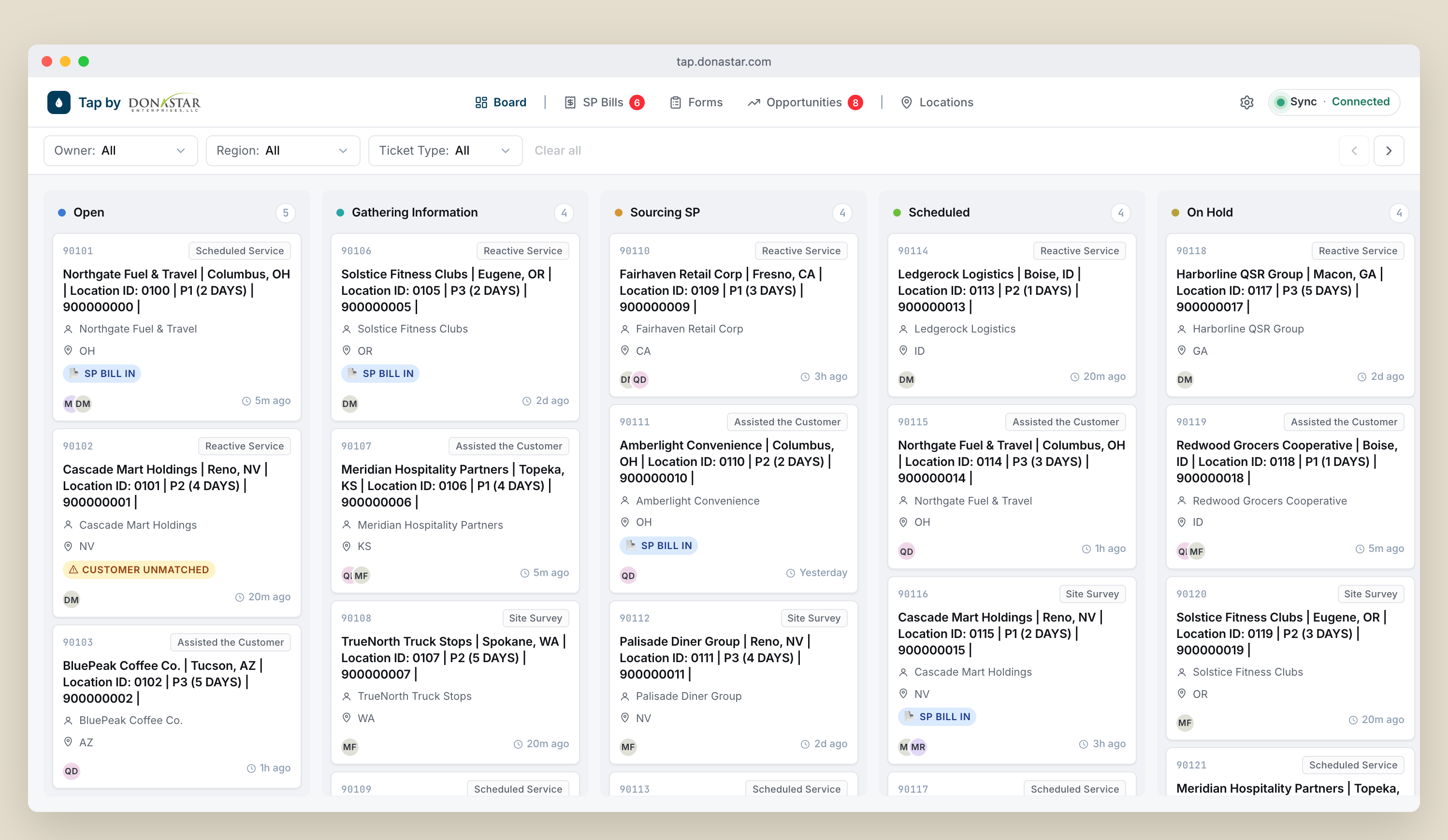
We kept Zoho and Striven exactly where they were, and built the connective tissue between them.

01

Sales orders create themselves

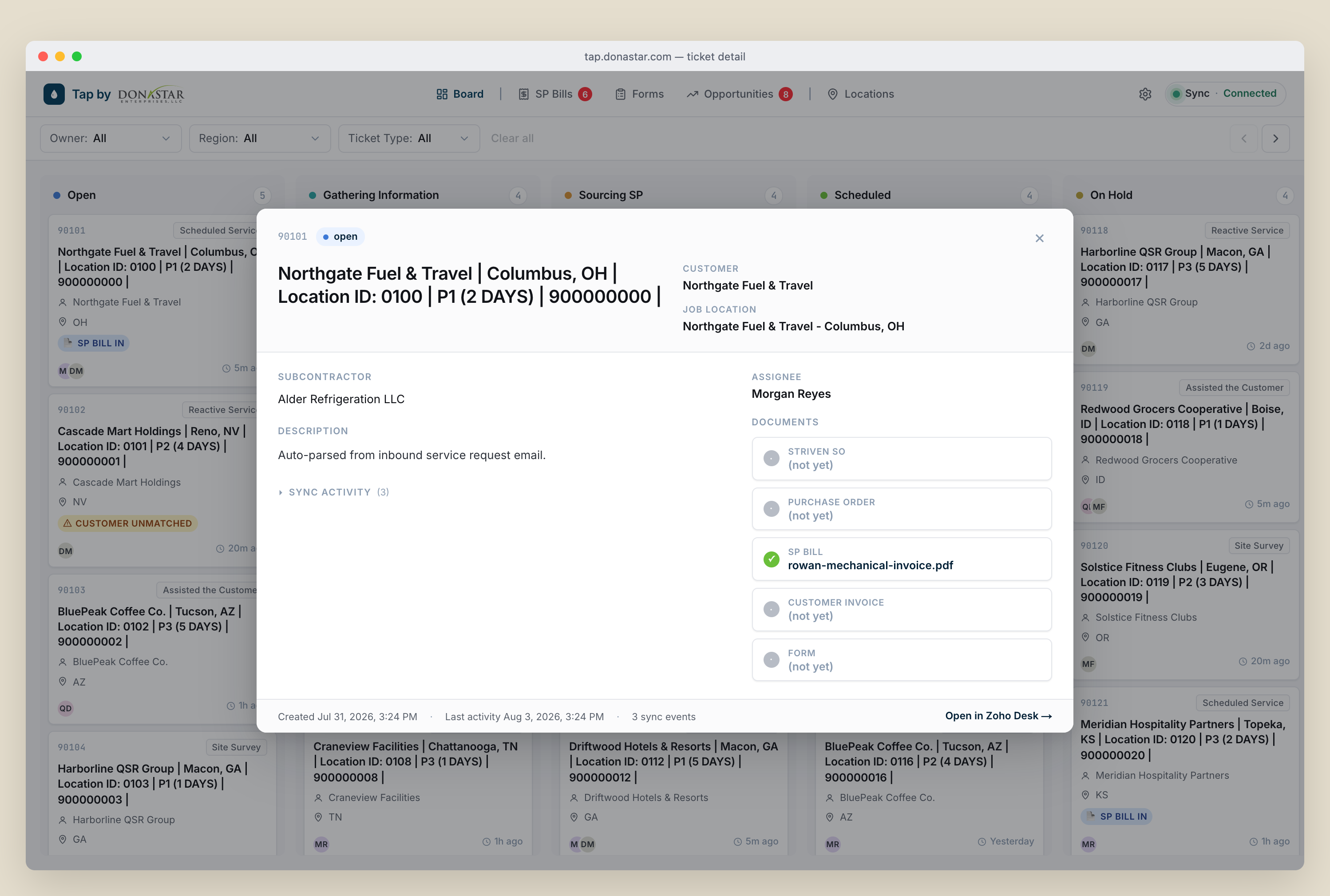
Move a ticket to "Sourcing SP" and TAP reads the email, identifies the customer and the service address, and creates a Striven sales order in about thirty seconds. Then it posts a comment back on the Zoho ticket showing exactly what it parsed, so a human can always see the machine's work.

02

Completion forms route themselves

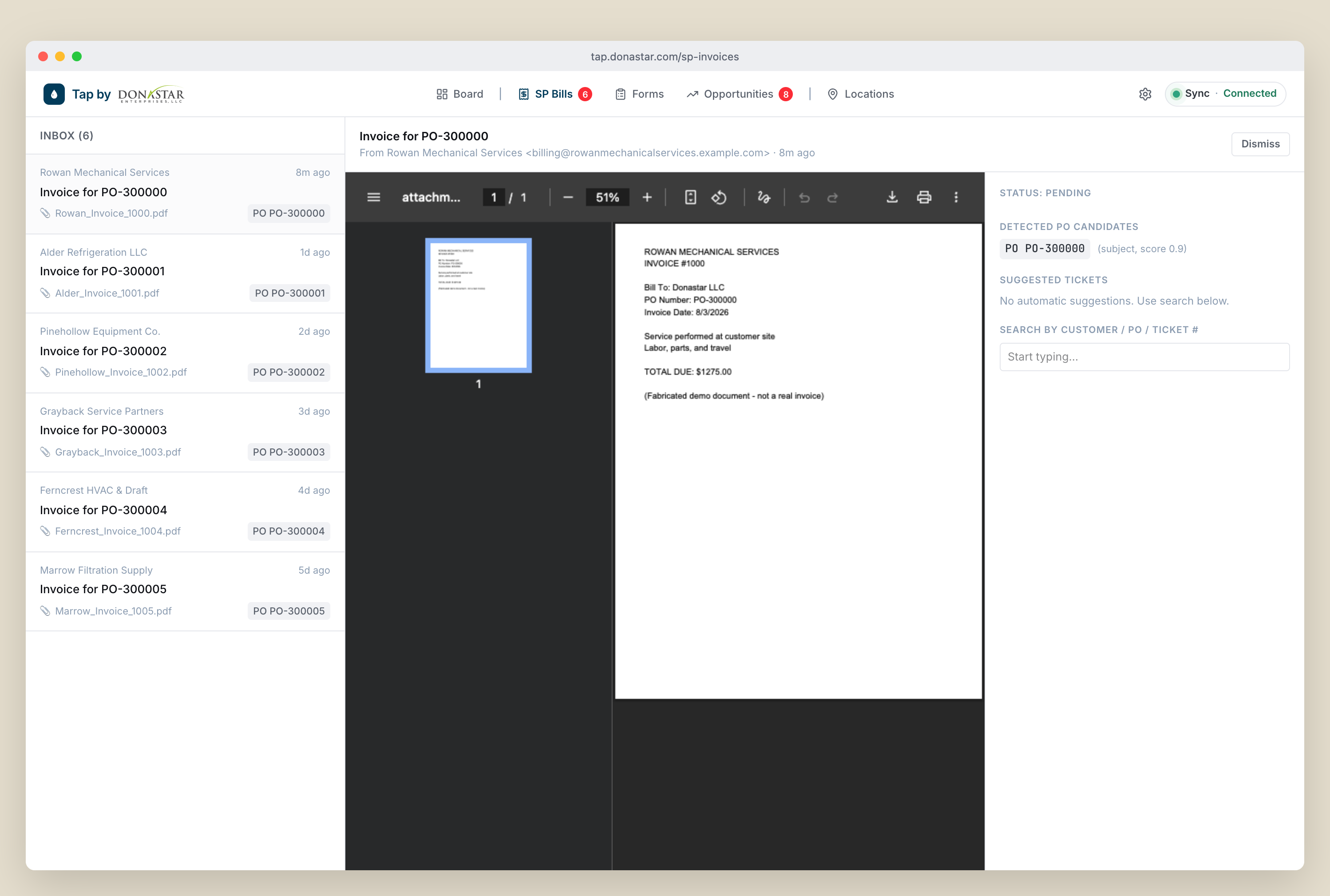
A provider submits the form, TAP matches it to the right ticket by PO number, and attaches the PDF and the photos automatically. The reply-all is dead.

03

Duplicates get caught

Aggregator tickets from ServiceChannel and ServiceNow are detected, tagged, and linked to the original instead of piling up on the board.

04

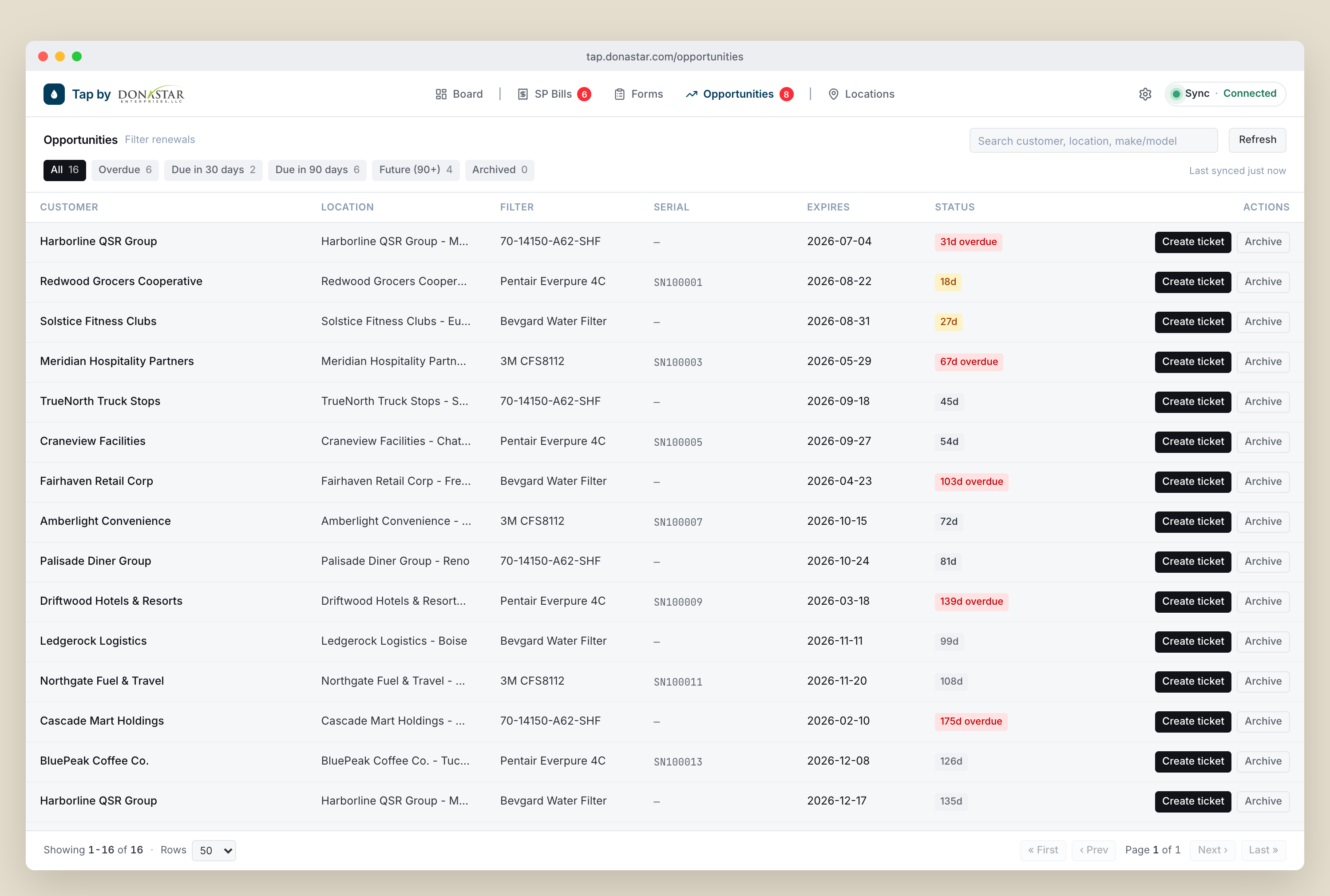
Expiring assets become tickets

TAP scans every filter asset in Striven each morning and opens a replacement ticket before the work goes cold. The filtration replacement pipeline runs itself now.

05

The team can finally see everything

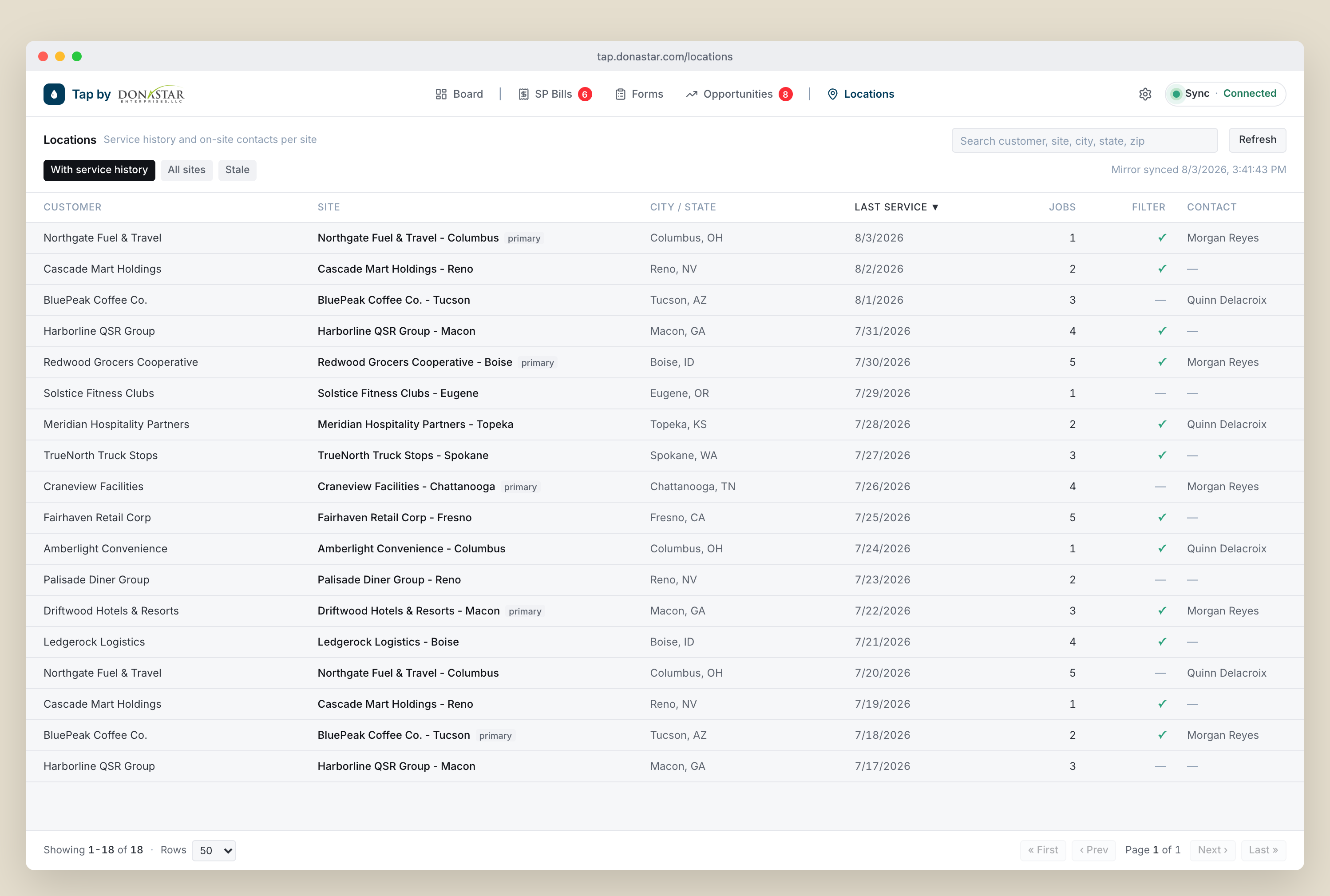
One board, every job, both systems. Ticket detail with the linked Striven records and the full sync history. Magic-link login, no passwords.

One design detail worth naming, because it shows the shape of the problem: neither Zoho nor Striven supports real-time webhooks. So TAP syncs on a schedule. The dashboard exists partly for the moments when someone needs a record updated right now, and one button does it. We designed around the real constraint instead of pretending it wasn't there.

Before - manual re-entry between systems
Before - two systems, filled by hand
After - TAP board, one view
After - one board, synced on a schedule

Donastar had been burned by a developer before. So transparency wasn't a nice-to-have on this project. It was the contract.

Fixed price, defined scope, phased delivery. No open meter.

Sandbox first, every time. Nothing touched production without testing and their sign-off. 337 automated tests, all green at handoff, because "seems to be working" is not the same as working.

Kickoff on April 16. Production cutover on May 28. A real handoff with a user guide, a team walkthrough, and a person who picks up the phone.

Thirteen days after cutover, pulled straight from the production database:

598 Tickets mapped
144 Sales orders auto-created
293 Duplicate tickets caught, 555 redundant aggregator updates ignored
96 Tickets with completion forms auto-attached
72 Provider bills routed out of 297 inbound emails
875 Status updates pushed to Zoho automatically
8,800+ Webhook events processed
337 Automated tests, all green

The copy-paste tax is gone. The hours that used to disappear into moving data between two systems now happen in the background, on a schedule, without anyone thinking about it. The team sees every job in one place for the first time. And when something goes wrong, it surfaces on the board today instead of in a phone call thirty days later.

Testimonial pending. Placeholder until Donastar provides a direct quote.

Donastar LLC Equipment servicing

The dashboard was never just a dashboard.

It's a data layer Donastar owns, sitting between the two systems, built to be extended without starting over. That's the difference between buying software and building it. When the tool fits the business instead of the other way around, everything after it gets cheaper.

A portal where service providers bid on jobs and upload their own bills. Profitability reporting that answers what each job actually made. AI agents that read an incoming request and draft the estimate before anyone opens the email. None of that is a rebuild. It's the next floor on a foundation that's already poured, and it's what Phase 2 is being built on right now.

No platform was built for a business like Donastar's. That used to be a problem you had to live with.

With AI changing the economics of custom software, it's starting to look more like an unfair advantage.

Running a business no software was built for?

Book a free 30-minute call. We'll talk through where your systems don't talk, what a custom build would actually take, and whether it's the right move.

Book a Call